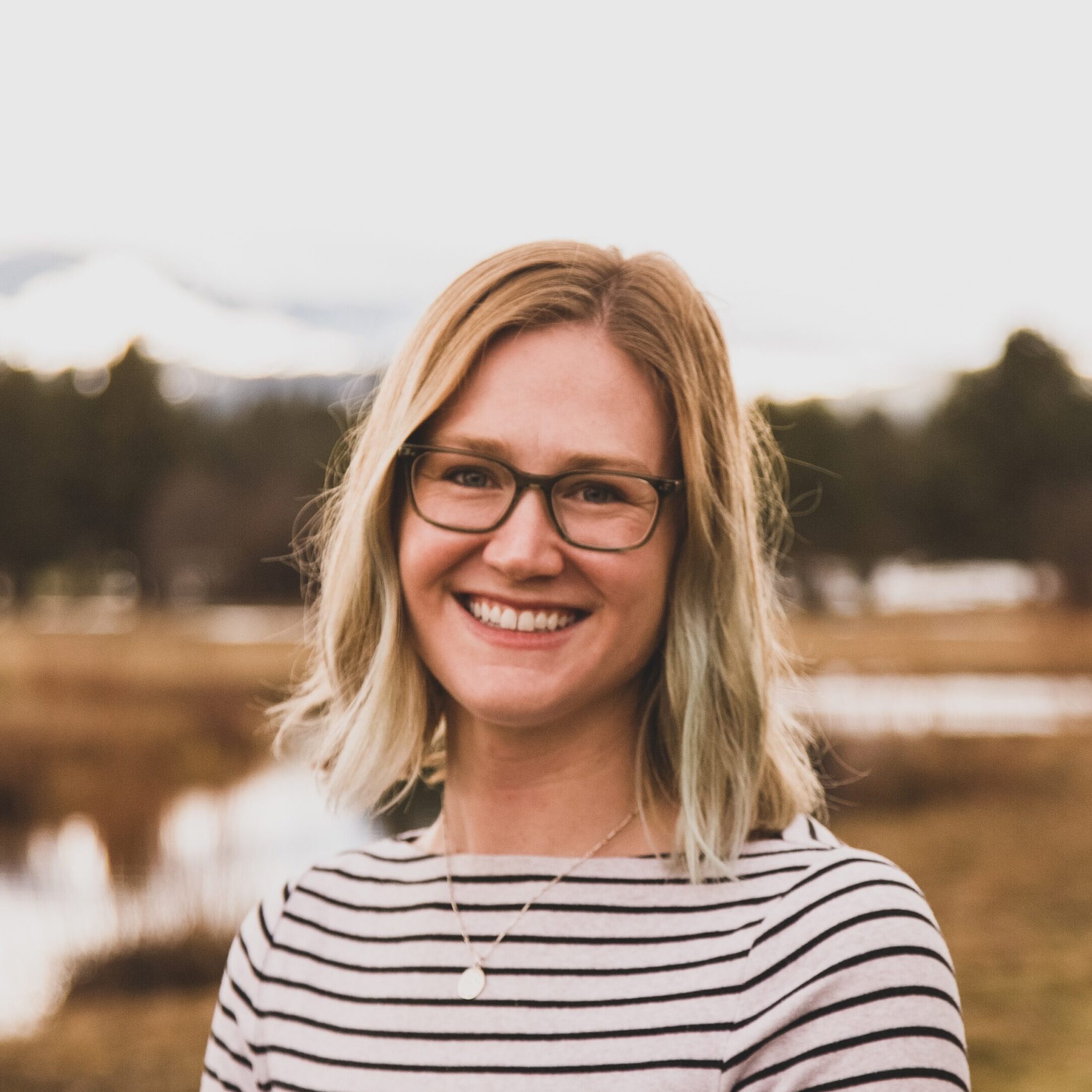
Community Highlight: Maureen Morrow
Introduce yourself and your work.
(Maureen Morrow) I am a biology professor at SUNY New Paltz, where I teach undergraduate microbiology and virology courses. I have been a member of the KBase Educators community since 2021 and I also serve on the steering committee for MICROnet (Microbiomes In Computational Research Opportunities Network). My research projects include the metagenomic analysis of a local, recovering wildfire site and the isolation, identification and genome analysis of bacteria from the long-term soil warming project in the Harvard Forest. The metagenome project has been supported through MICROnet. As a professor at a primarily undergraduate institution, I aim to connect research projects with my classes and with student research opportunities.
How has using KBase supported your role as an instructor?
(MM) My teaching philosophy is based on providing students with active learning experiences, such as applying course concepts to a project. For many years, I have included BLAST bioinformatics activities in my classes. Now, with KBase, I have been able to expand the opportunities for students to ask and answer “big data” based questions. Students with interests in biochemistry, medicine, environmental biology, etc. are better prepared for the future with an understanding of big data. With KBase, they can perform bioinformatics analysis without first learning command-line programming. This well-supported platform makes it easy to teach the next generation to think about and work with the type of data that will increasingly influence our lives.
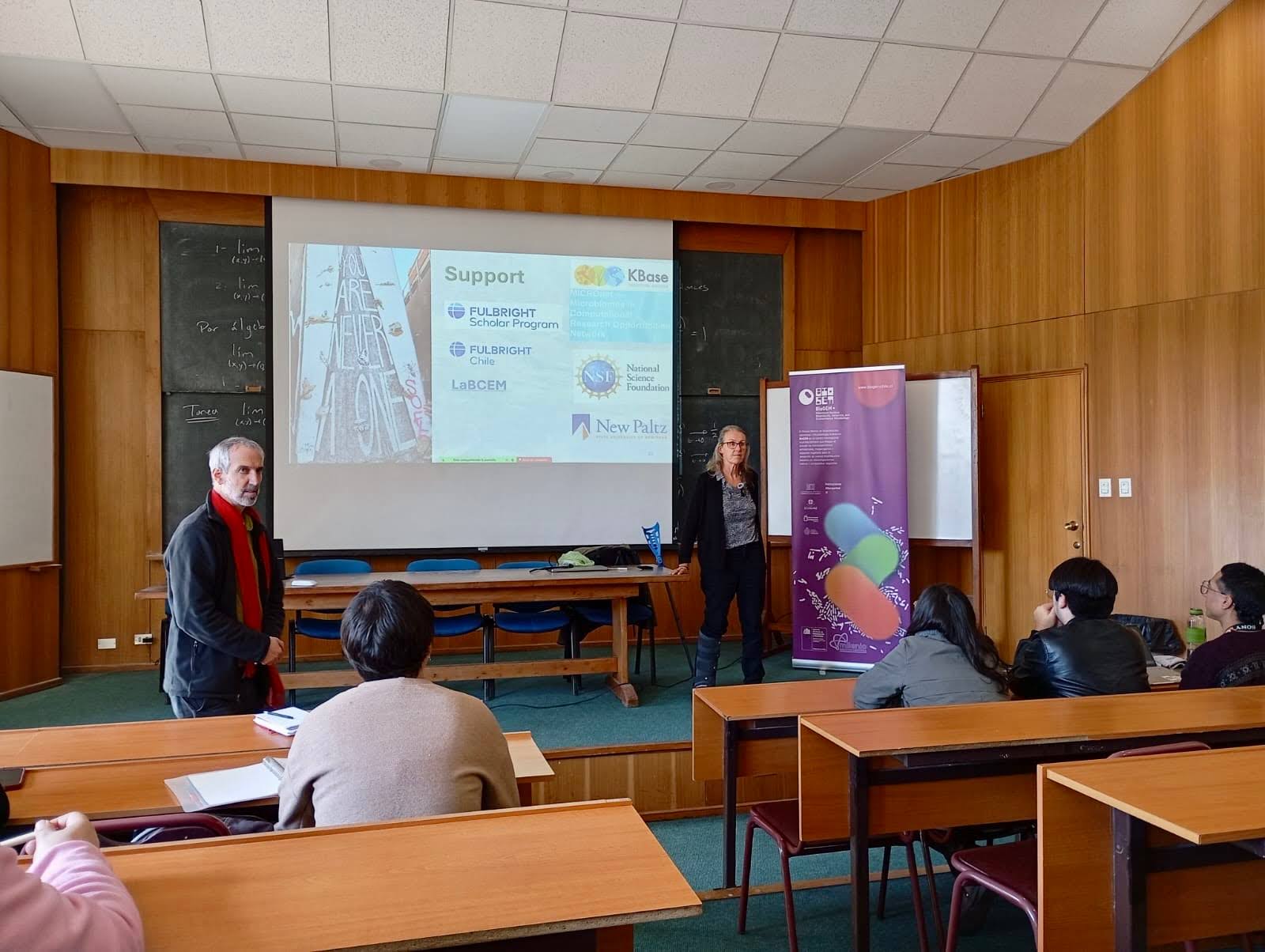
Maureen Morrow presenting research at the XXII Coloquios de Microbiologia, Universidad Técnica Federico Santa María Valparaiso, Chile. Photo courtesy of Roberto Orellana, Universidad de Playa Ancha.
This past fall, I had the rewarding experience of working with KBase to teach and do research as a Fulbright Scholar at the Universidad de Playa Ancha (UPLA) in Valparaíso, Chile. I leveraged the KBase Educators modules that had been translated into Spanish. These served as the basis of the modules I developed in collaboration with my UPLA colleague, Dr. Roberto Orellana. Building on his interests in marine sediment bacteria and metabolic diversity, we developed a Narrative to enable students to analyze annotated genomes and consider, among other things, the electron sources and final electron acceptors available in anaerobic environments.
While in Chile, I also used KBase to analyze metagenomic data from a biopile bioremediation experiment. This analysis is associated with the bioremediation project underway at the hydrocarbon contaminated Las Salinas site in Viña del Mar, Chile. I presented a poster describing the extracted MAGs at a European Molecular Biology Organization course on bioremediation held in Valparaíso. Several of our MAGs represent new species of bacteria and we expect that this data will contribute to our understanding of bioremediation processes. I look forward to continuing this collaboration, as well as, supporting the use of KBase for additional projects.
Do you have a favorite part about KBase?
(MM) My favorite aspect of KBase is the user support. The modules (available to educators through the KBase Educators Org) and YouTube tutorials are great for exploring the variety of tools on the platform. I also really value the more individual support available on the help board and Slack. I would also like to mention how fulfilling it is when students tell me that the KBase assignments made my course their favorite.

UPLA students working on KBase Narrative analysis in class. Photo courtesy of Roberto Orellana, Universidad de Playa Ancha.
What role do you see KBase having in open science principles?
(MM) With regard to Open Science, an important aspect of KBase is the ability to produce public Narratives. In these Narratives, you can share each step of the bioinformatics analysis, which is a superior form of communication than the methods section in many papers. Also, when considering the UNESCO recommendations on Open Science, KBase is useful for sharing information, has Spanish language modules and enables people without command-line skills to perform bioinformatics research.
Can you share a tip for using KBase?
(MM) When you configure an app, the name you choose for the output object should be thoughtfully considered if you are going to use downstream apps and/or run many samples. This and other aspects of data organization require time spent using the platform, but it is enjoyable to explore apps beyond the ‘plug-and-play’ modules.
References & Links
Fisher T. Durmazolu F., DeAngelis KM., Morrow MA (2023) Complete genome sequence of Bradyrhizobium NP1, isolated from forest soil. Microbiology Resource Announcements. https://doi.org/10.1128/MRA.00585-23; Static KBase Narrative: https://kbase.us/n/147325/113/
Ahmed H, DeAngelis KM., Morrow MA (2022) Draft Genome Sequence of Leifsonia poae strain BS71, Isolated from a Drought Microcosm. Microbiology Resource Announcements Volume 11 issue 1 e00951-21 DOI: https://doi.org/10.1128/mra.00951-21
Funding
Laboratorio de Biología Celular y Ecofisiología Microbiana
MICROnet (For SUNY New Paltz courses; NSF award # 2418285)