Community Highlight: Alvaro Munoz Plominsky
Alvaro Munoz Plominksy (AMP) recently began a Research Associate position at the Hallam lab in the University of British Columbia (Vancouver, Canada). Before moving there, he worked as a postdoctoral researcher in the Bartlett Lab (https://bartlettlab.ucsd.edu/) at the University of California – San Diego (UCSD) on an international collaborative research project, alongside microbiologists, geobiologists, and engineers from UCSD, San Diego State University, Universidad de Concepcion (Chile), University of Southern Denmark, Institut François Jacob (France), and the University of Rhode Island. The team includes individuals across all career levels from undergraduates and graduate students to research professionals and professors.
How has using KBase supported your research/project?
(AMP) Our study explores the sensitivity of deep-sea microbes to decompression and temperature shifts when collected using traditional oceanographic instrumentation. We were granted federal funds (NOAA award NA17OAR0110212 and NSF awards #1635466, and #2049515) to refine and apply the technology needed to enable the collection of seawater samples without substantial pressure and temperature changes during recovery at any oceanic depth (Peoples et al., 2019). These new systems were then evaluated during scientific cruises in the San Clemente Basin off the coast of San Diego, the Atacama Trench, and the Puerto Rico Trench (Plominsky et al., 2026).
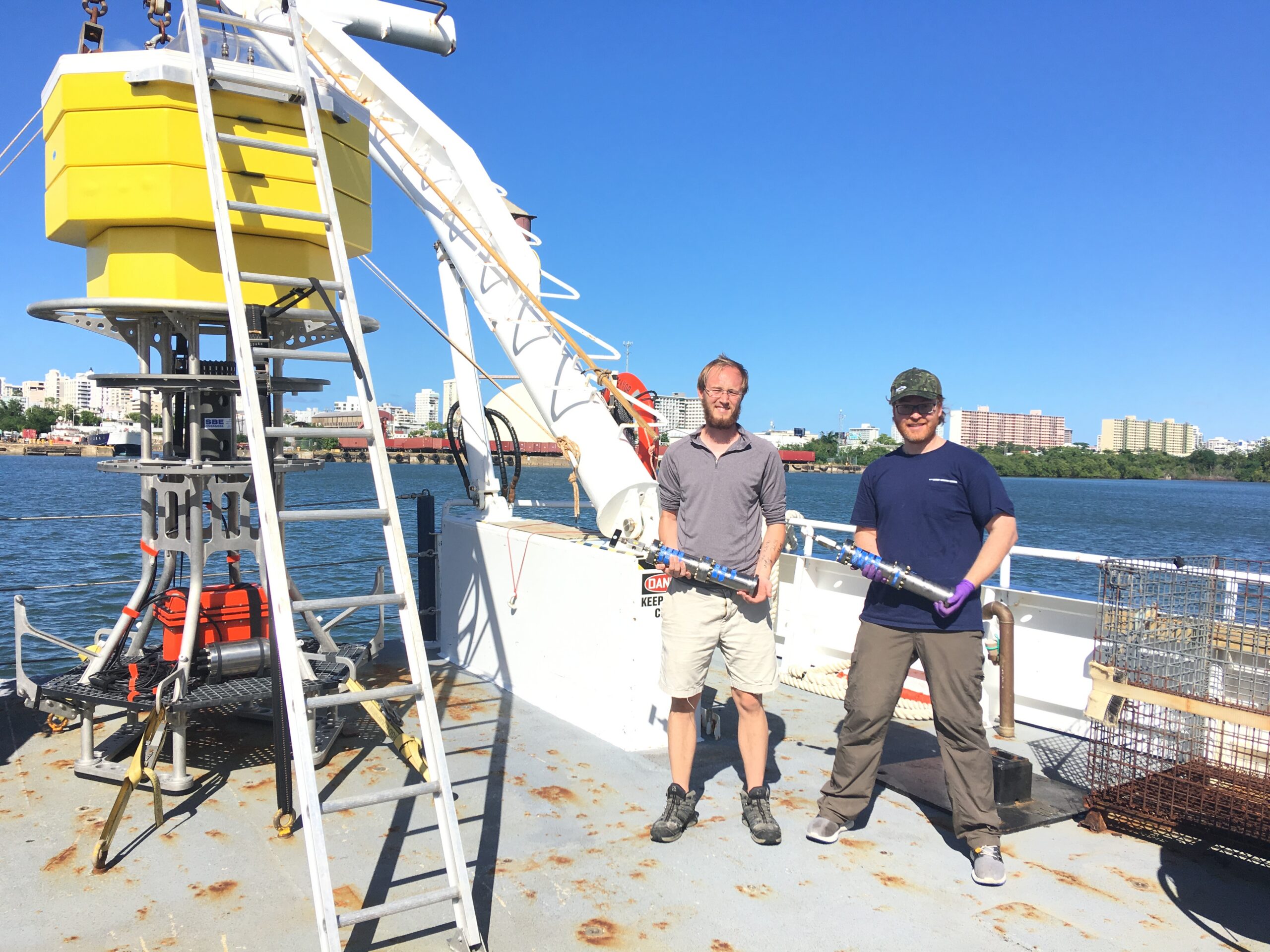
Alvaro Munoz Plominsky, PhD and Logan Peoples, PhD on the Puerto Rico Trench Cruise holding a Pressure Retaining Sampler (PRS). Peoples led the development of the PRS during his PhD. They are standing in front of the Deep Autonomous Profiler (DAP), which was developed by Dr. Christopher Roman and Dr. Steve D’Hondt to sample various depths across the ocean during a single deployment. Photo courtesy of Alvaro Munoz Plominsky.
How have you benefited from working with KBase?
(AMP) Although there definitely are bioinformatic resources and expertise within the close vicinity of our collaborative team, it was much easier (for me) to dive into KBase and apply established data processing pipelines. This made the work very manageable, even considering the large amount of the data we generated (i.e. >30 metagenomes encompassing >600 Gbp).
What is your favorite part about using KBase?
(AMP) The KBase platform allowed us to organize the methods with each processing step and intermediate data products of our research in a format shareable with reviewers to revise as necessary. We were also able to then share this with collaborators and the general public through the static Narrative that KBase can generate, providing everyone with access to the study information and to see exactly how the data was processed to generate the published outcome.
See the research workflows in their Narratives here: Sequence Quality Filtration and Assemble (https://doi.org/10.25982/90888.1452/2327015) and Decontamination through Metagenomic Fractionation and Analysis of Metabolic Potential (https://doi.org/10.25982/138628.97/2327013).
What role do you see KBase having in open science principles?
(AMP) Currently, most studies have an array of bioinformatic processing steps before they reach a publishable output. This dilutes the key reproducibility aspect in modern genomics and increases the gap between scientists from top research institutions with the rest of the world. KBase overcomes many of these problems by allowing researchers to deposit all of their data products (raw, intermediate, and final) and use the same bioinformatic tools. This functionally paired with online tutorials and webinars enable anyone to download a dataset and integrate it to its own study or teaching activity. Furthermore, since it bypasses the installation of software and their dependencies, I have found that KBase is the easiest way to get graduate and undergraduate students in our lab to become confident and more interested with the various bioinformatic processing steps of our (meta)genomic data.
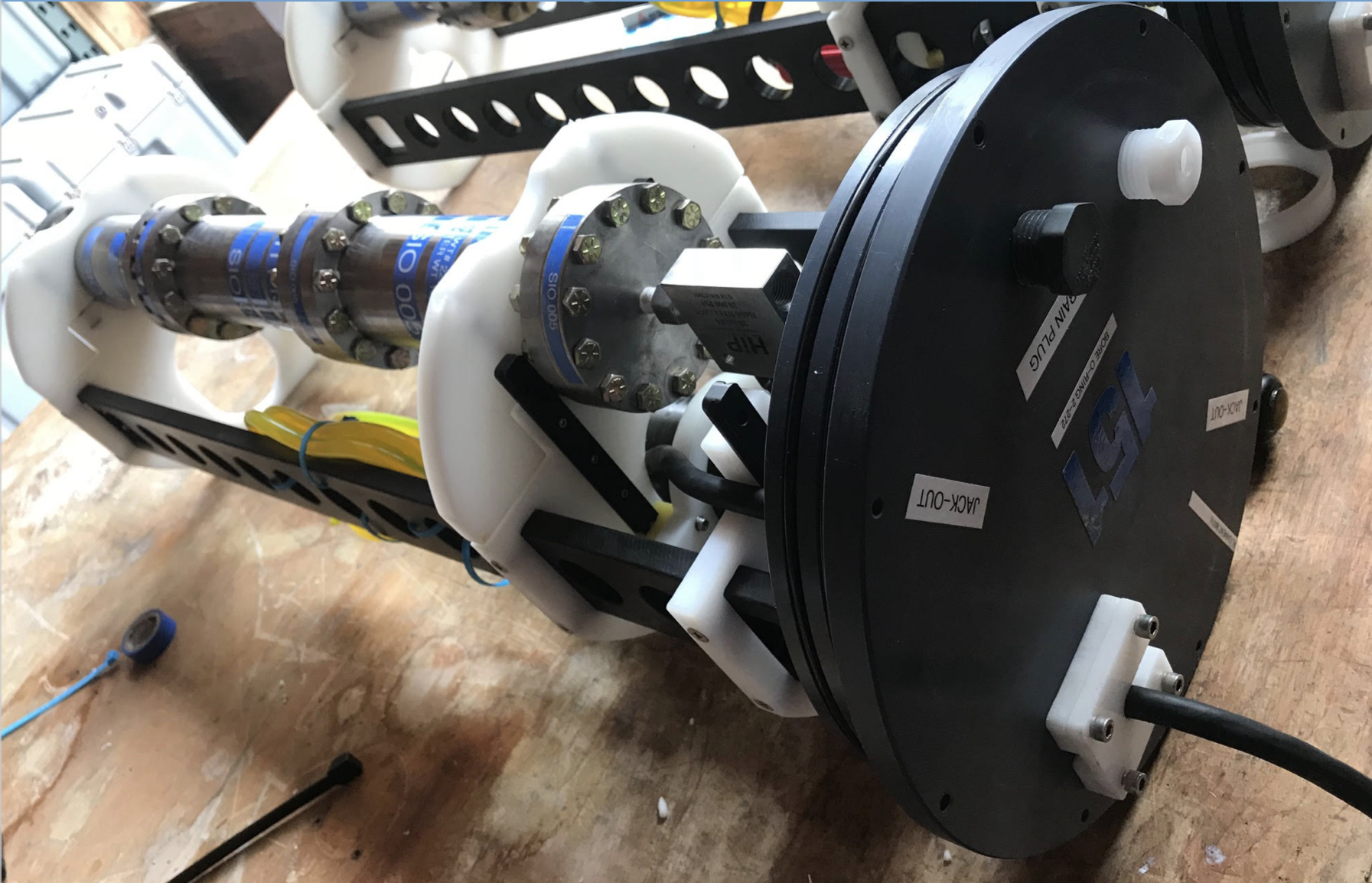
Internal components of the Pressure Retaining Sampler (PRS) that are mounted to the inside rails that insert to the plastic casing that is secured to the side of the DAP frame. Matthew Norenberg, Senior Marine Mechanician, originated and optimized this mount-casing design. Photo courtesy of Alvaro Munoz Plominsky.
What is one “behind the scenes” thing you want to share about your project?
(AMP) Our study clearly shows that conventional oceanographic sampling instruments decompress and warm deep-sea samples during retrieval. Decompressing and warming the samples alters the prokaryotic cells retrieved by reducing their total numbers, diminishing their activity, and causing overall shifts in community composition. Now, we want to share our findings with the scientific community, so future studies may take this bias into consideration for experimental design to continue to improve our understanding of deep-sea microbial ecology and biogeochemistry.
Links and References
L.M. Peoples, et al. “A full-ocean-depth rated modular lander and pressure-retaining sampler capable of collecting hadal-endemic microbes under in situ conditions.” Deep Sea Research Part I: Oceanographic Research Papers 143: 50-7. (2019). [DOI: 10.1016/j.dsr.2018.11.010]
A.M. Plominsky, et al. “Minimising decompression and warming during deep seawater collection increases abundance and activity of autochthonous bacteria and archaea.” The ISME Journal wrag064. (2026). [DOI: 10.1093/ismejo/wrag064]
Funding