
Community Highlight: Olubukola Babalola
Professor Olubukola Oluranti Babalola is Professor and Principal Investigator at North-West University (NWU) in South Africa, where she previously led the Food Security and Safety Research Focus Area, and an Honorary Visiting Professor at Imperial College London. Her work in microbial biotechnology directly addresses global challenges in agricultural sustainability, food security, and climate resilience.
Professor Babalola has over 22 years of research experience in rhizosphere metagenomics. Her scientific contributions focus heavily on:
- Soil-Plant-Microbe Interactions: Mapping the intricate biological ecosystems surrounding plant roots (the rhizosphere) to discover how beneficial microbes can enhance crop growth.
- Biofertilizers & Biocontrol: Developing sustainable alternatives to chemical fertilizers using plant-growth-promoting microorganisms.
- Climate Stress Mitigation: Engineering microbial solutions that safeguard essential crops against devastating environmental factors like drought, heat stress, and parasitic weeds.
- Metagenomic Analysis: Utilizing “meta-omics” to evaluate soil profiles and crop environments without relying strictly on traditional culture-based laboratory techniques.
Beyond her laboratory work, Professor Babalola is a highly influential international figure in science diplomacy, academic publishing, and gender equity in STEM:
- UNESCO-TWAS: She serves as the Vice-President of The World Academy of Sciences for the African region.
- UNESCO-OWSD: She is the former Vice-President of the Organization for Women in Science for the Developing World for Africa, where she spent years accelerating careers for female scientists.
- Imperial College London Role: At Imperial College London, her visiting professorship involves facilitating international academic exchanges, lecturing on advanced microbiome modules, and supervising postgraduate research students.
- High-Impact Publishing: With an H-index exceeding 90 and over 450 publications to her name, she was recognized in the top 1% of highly cited researchers globally by Clarivate. Her recent major literature includes the comprehensive book Food Security and Safety: Africa’s Perspective.
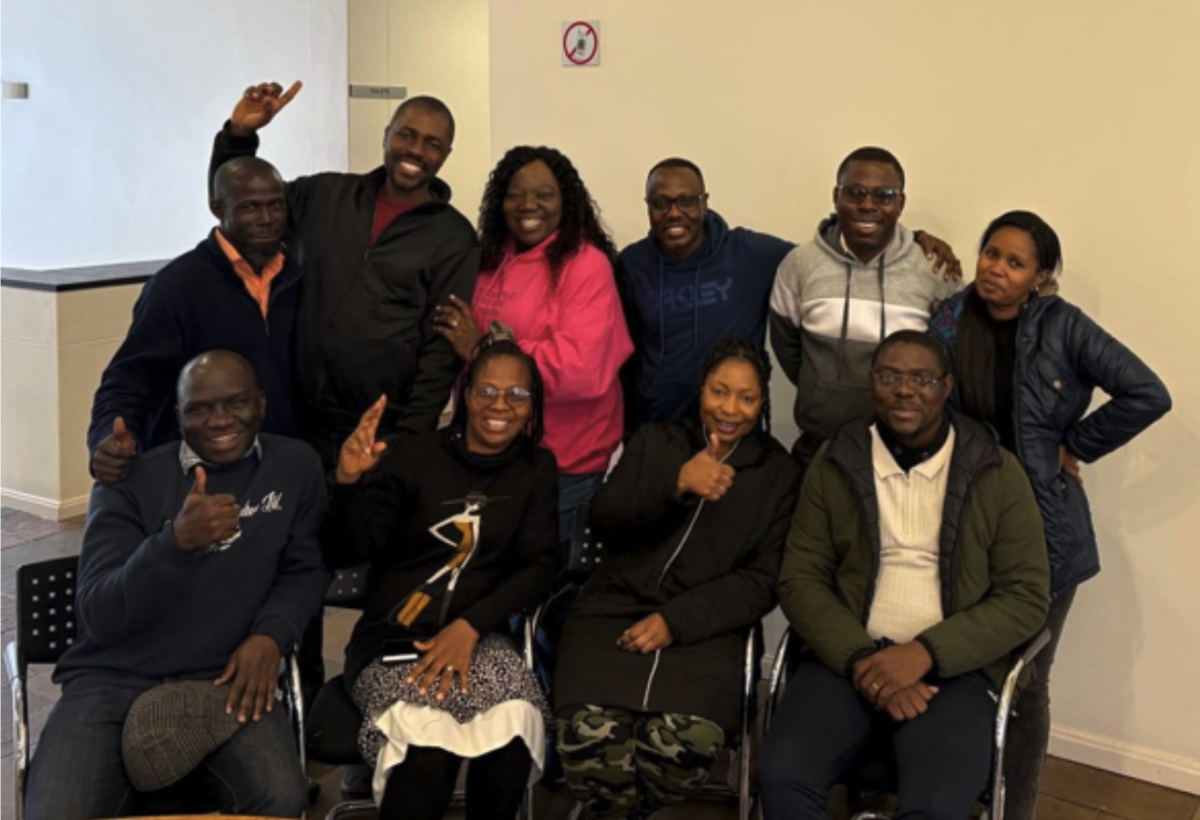
Babalola Lab group picture taken during one of the biotech trainings in South Africa
How has using KBase supported your work? OR How have you benefited from working with KBase?
(OO) KBase has significantly supported the work of our laboratory (plant-microbe interaction laboratory) at North-West University, South Africa, by providing an integrated platform for genome assembly, annotation, metabolic modelling, and comparative analyses. At our lab, we do not need to rely on multiple disconnected bioinformatics tools to perform a large portion of our shotgun metagenomic workflows. KBase has streamlined our analyses of rhizosphere, soil, and manure-associated microbiomes and improved workflow efficiency across projects.
The KBase platform has been especially valuable for functional annotation and metabolic reconstruction. Our laboratory investigates microbial ecology, rhizomicrobiome function, and crop–livestock interactions, and KBase enables us to link taxonomic profiles to microbial functional potential. Using KBase, we can identify pathways associated with carbohydrate-active enzymes, biomass degradation, nutrient cycling, and other agriculturally relevant processes. These analyses provide important biological insights into microbial contributions to sustainable agriculture and environmental resilience.
KBase has also enhanced collaboration within our research group and across institutions. The Narrative interface allows our team to document workflows, track analytical steps, and share results transparently with collaborators in South Africa and international partner institutions. This has improved reproducibility, facilitated collaborative interpretation of data, and strengthened multidisciplinary research efforts.
Do you have a favorite part about KBase?
(OO) One of the most valuable features of KBase for our laboratory is the Narrative interface. It functions both as an analytical workspace and as a research documentation environment where analyses, methods, results, and interpretations can all be integrated in one place. This eliminates the need to manage multiple disconnected scripts, notebooks, and documentation files. The ability to share Narratives also greatly improves collaboration and transparency within our team and with external collaborators.
Our laboratory also highly values the metagenomics and metabolic modeling pipelines available within KBase. The platform allows us to move from raw sequencing data to annotated genomes and functional insights within a unified system. This has been particularly beneficial for studying complex microbial communities such as rhizosphere microbiomes and agricultural waste-associated microbiota. KBase helps transform large-scale sequencing data into biologically meaningful interpretations that support our research on microbial ecology and sustainable agriculture.
The KBase platform also provides access to high-performance computational resources without requiring extensive command-line expertise. This has enabled members of our laboratory, including students and early-career researchers, to perform advanced bioinformatics analyses while still allowing more experienced users to run sophisticated, customizable workflows. Overall, KBase has expanded our laboratory’s analytical capacity and accelerated our metagenomic research.
What role do you see KBase having in open science principles?
(OO) KBase plays an important role in advancing open science by promoting transparency and reproducibility in research. Through the Narrative interface, every stage of an analysis, including datasets, tools, parameters, and outputs, can be documented and shared. This allows other researchers to understand, evaluate, reproduce, and build upon published work, helping to address ongoing reproducibility challenges in computational biology and microbiome science. By providing free access to advanced computational tools and high-performance computing resources, KBase platform lowers barriers for researchers and institutions with limited bioinformatics infrastructure. This is particularly important for our laboratories in resource-constrained settings and contributes to a more inclusive global scientific community. Another important contribution of KBase to open science is its support for collaboration and knowledge sharing. Researchers can share Narratives, workflows, and results with collaborators, enabling teams to work more efficiently and avoid duplication of effort. This collaborative environment accelerates scientific discovery and strengthens interdisciplinary research networks.
Can you share one “behind the scenes” thing about your work?
(OO) One important “behind the scenes” aspect of our laboratory’s work is that shotgun metagenomic analysis is rarely straightforward. Initial assemblies from rhizosphere, soil, or manure-associated microbiomes often require extensive optimization and refinement before meaningful biological interpretation can be achieved. Our laboratory routinely performs multiple rounds of quality control, including adapter trimming, filtering low-quality reads, and evaluating sequencing depth and coverage. We frequently compare assembly strategies and parameter settings in KBase to determine which approaches yield the best contig quality, genome recovery, and binning performance for specific datasets. Even after metagenome-assembled genomes have been generated, substantial downstream refinement is often required. This includes contamination removal, completeness improvement, taxonomic validation, and functional verification. One of the major advantages of KBase is that the entire analytical process is captured within Narratives, allowing our team to revisit, refine, and reproduce workflows without restarting analyses from the beginning.
References & Links
O.O. Babalola, R. R. Molefe, and A. E. Amoo. “Metagenome assembly and annotation of data from the rhizosphere soil of drought-stressed CRN-3505 maize cultivar.” Data in Brief 57: 110966. (2024). [DOI: 10.1016/j.dib.2024.110966}
O.O. Babalola, R. R. Molefe, and A. E. Amoo. “Metagenome Assembly and Metagenome-Assembled Genome Sequences from the Rhizosphere of Maize Plants in Mafikeng, South Africa.” Microbiology Resource Announcements 10: e00954-20. (2021). [DOI: 10.1128/mra.00954-20]
Public Narrative: https://narrative.kbase.us/narrative/213475
Funding sources:
- National Research Foundation (NRF), South Africa
- International Centre for Genetic Engineering and Biotechnology (ICGEB), Italy

