Quarterly User Update (July – September 2026)
This update covers activities and events from July through September 2026 – celebrating accomplishments from our team, users, and collaborators.This quarter, we feature stories of science and community-focused training events across continents.
Community Highlights
Over the past few months, our community shared how they have used KBase to advance their research and support their teams. In July, Dr. Alvaro Munoz Plominsky shared his use of the platform in research behind innovative methods to sample deep sea microbes without impacting the communities undergoing substantial pressure and temperature changes while collecting samples (https://www.kbase.us/news/alvaro-munoz-plominsky/). In August, Dr. Olubukola Babalola shared how her lab at North-West University in South Africa has leveraged the KBase Narratives to streamline metagenomics analysis investigating plant-microbe interactions and improve research workflows across projects (https://www.kbase.us/news/olubukola-babalola/).
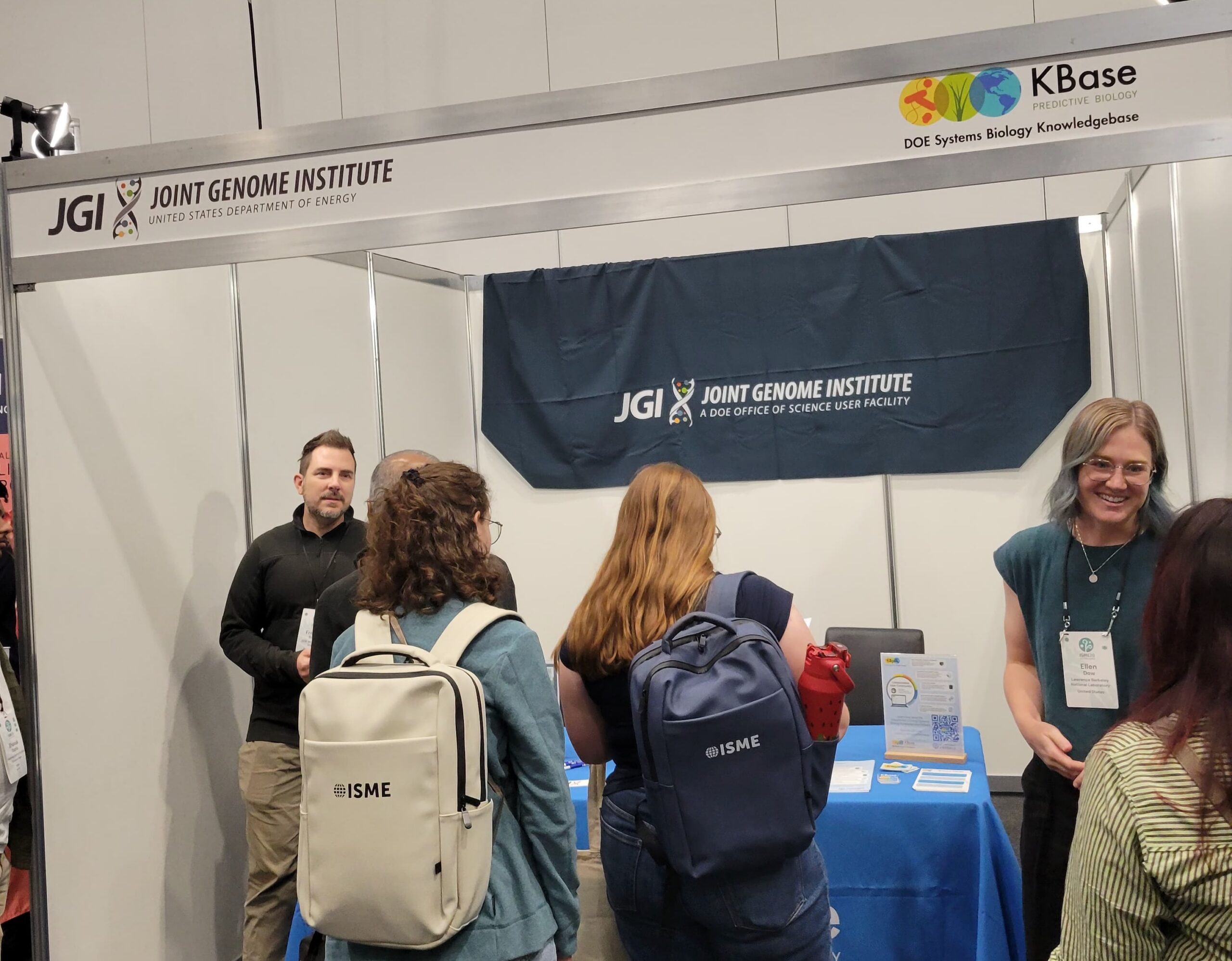
The shared KBase and Joint Genome Institute booth at ISME20.
KBase also traveled to the 20th International Symposium for Microbial Ecology (ISME20) in Auckland, NZ. At ISME20, the KBase team presented across four sessions that included two talks, a poster, and facilitating a roundtable discussion. Details on the presentations and sessions are available at https://www.kbase.us/news/isme20-events/.
If you are interested in sharing your work or projects in a KBase Highlight, email us at [email protected].
KBase Publications
The platform and team behind KBase continues to support users to analyze their data and follow the FAIR (findable, accessible, interoperable, reusable) data principles through to publication. Studies published this quarter included:
- Investigating parasite-host responses through comparative genomic and transcriptomic analysis of a chytrid fungal parasite and its aquatic cyanobacterium host (McKindles et al. 2026);
- Effectiveness of commensal biofilms to protect copper from corrosion caused by sulfate-reducing bacteria (Sigdel, et al. 2026);
- Outcomes from a crowdfunded workshop in February that trained students in metagenomic data analysis as a follow-up to a citizen science environmental microbiome sampling campaign (Ghisleni et al. 2026).
All publications using KBase are available at: https://www.kbase.us/research. If we are missing your publication citing KBase in your methods, please let us know at [email protected].
Training & Workshops
The KBase team took part in three in-person workshops hosted by various collaborators over the summer.
The KBase team took part in three in-person workshops hosted by various collaborators over the summer. These workshops included:
- Plant-associated microbial communities at Texas A&M University Department of Plant Pathology and Microbiology;
- Isolate analysis from sequences through comparing annotated genomes for students in the Microbial Diversity Course at the Marine Biological Laboratory in Woods Hole, MA;
- Community metagenomics and data standards in collaboration with the Australian Microbiome project in Brisbane, Australia at the University of Queensland – St. Lucia.
Dr. Rian Pierneef led another successful regional training workshop in Africa during September on “Reads2Genomes: Reconstructing SAGs and MAGs with KBase.” One participant shared their takeaways and benefits from the workshop on LinkedIn, which can be read here: https://lnkd.in/p/gCpXuKd8
Lastly, the KBase outreach team kicked off a four-part series with ASM on the “Advanced genomic feature analysis using open access tools,” beginning with feature analysis in KBase on September 17th (https://asm.org/webinars/advanced-genomic-feature-analysis-using-open-acces). This virtual series goes beyond genome assembly and annotation to use a variety of tools and workflows available in KBase with hands-on practice for participants.
Summary
To close out our update, below is a graphical summary documenting our Q3 July through September 2026 user numbers. Keep doing great science in KBase. Remember, the KBase team is here to support you!
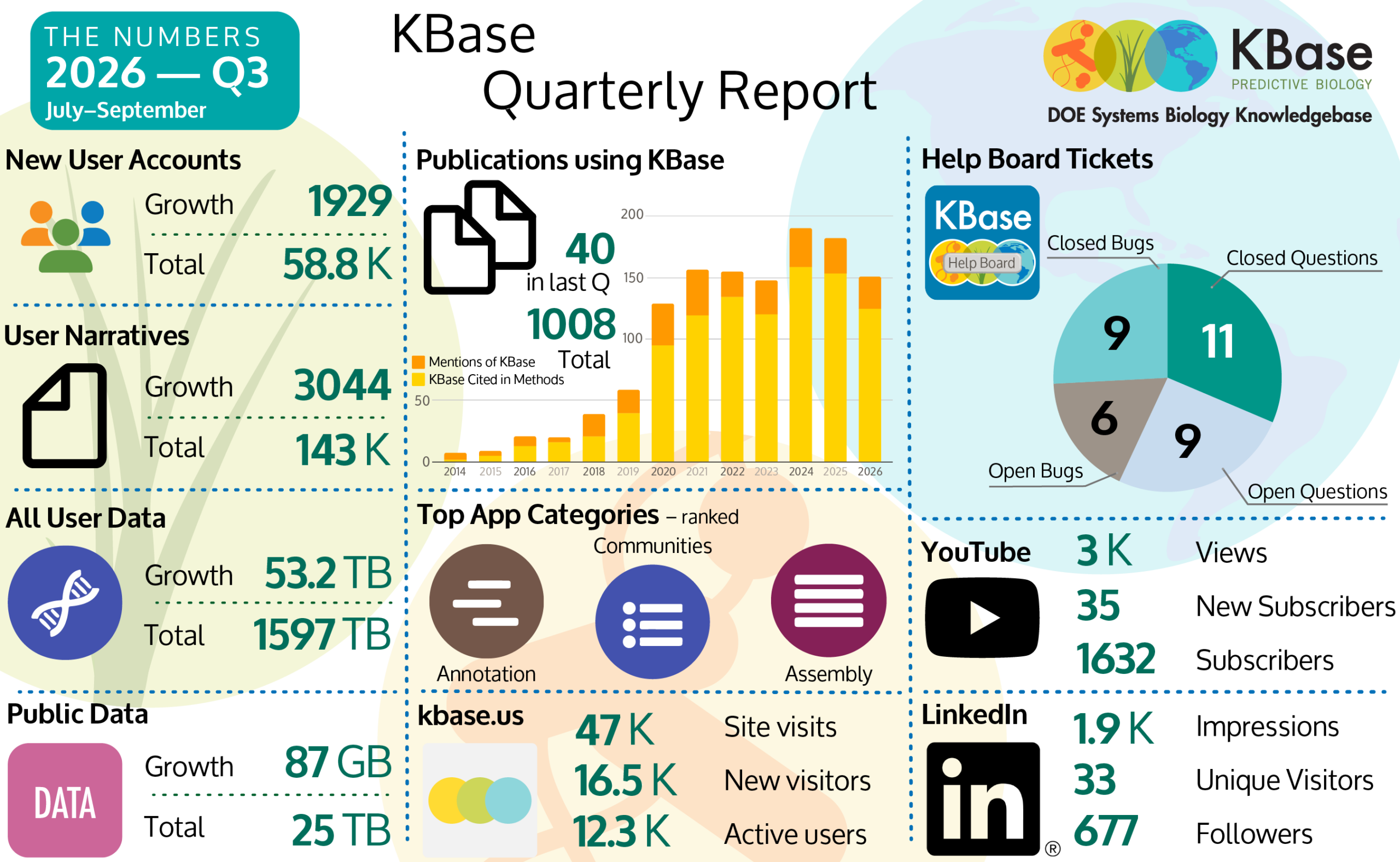
KBase by the numbers from July through September 2026.